How Porsche Perfected One Idea
Iteration over reinvention
I’ve always been into cars growing up. I’ve always been that person who notices when a nice car drives past, the way it looks, the sound of it, just the whole thing. But something I’ve noticed more recently is how much more people seem to be appreciating Porsche. It feels like in the last couple of years there’s been a real shift where people are starting to properly recognise what they’re doing, especially with the Porsche 911. It’s not that Porsche wasn’t respected before, but now it feels like people are actually understanding why it’s so well designed.
For me, that appreciation has kind of always been there. Even when I was younger, there was something about Porsche that felt different. They were never the most outrageous or flashy cars like a lot of other supercar brands, but there was something clean and controlled about them. They felt considered. A lot of brands in that space chase attention, the loudest design, the most aggressive look, the fastest headline numbers. Porsche doesn’t really do that, and I think that’s exactly why it stands out.


What makes Porsche interesting to me is that their design isn’t about dramatic change, it’s about discipline. And by discipline, I mean not changing things just because you can. It’s having the restraint to stick with something that works and being confident enough to keep refining it. There’s this pressure now for brands to constantly reinvent themselves, to release something completely new every few years, but Porsche has gone the opposite way. They’ve committed to a direction and just kept improving it.
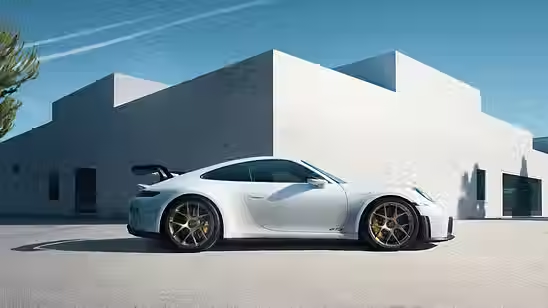
If you look at the 911 specifically, it’s probably one of the best examples of this. The original and the current version are clearly related. Same silhouette, same proportions, the same overall identity. But at the same time, everything has been refined. The surfaces are smoother, the stance is wider, the lighting has evolved, and the materials have improved. Nothing feels random. It’s not one big redesign, it’s loads of small, deliberate improvements stacked over time, which is why it feels so resolved as a product.
Another reason it works so well is that the design is so tied to the engineering. The shape isn’t just for looks, it comes from how the car actually works. The rear engine layout, the weight distribution, the aerodynamics, all of that feeds directly into the form. And that’s something you can feel when you drive it. Porsche has never really chased being the most powerful or fastest in a straight line, they’ve focused more on balance, handling, and precision, which, in my opinion, is a much more meaningful way to design a performance car.
You can see that even more when you compare it to brands like Ferrari and Lamborghini. Their cars are designed to grab attention instantly. More lines, more vents, more aggressive shapes, everything is pushed to look dramatic and eye-catching. And that’s not necessarily a bad thing, it’s just a completely different approach. It’s more about spectacle and emotion. But sometimes it can feel like it’s trying too hard, and that’s where it starts to lose that sense of longevity.


Porsche, on the other hand, feels more restrained. The design is cleaner and more controlled, which means it ages better. It’s not just trying to impress you in the moment, it’s designed to still look right years later. That’s why older 911s still look so good today. The simplicity in the form, the consistency in proportions, and the lack of trend-driven features mean they don’t really date themselves in the same way.
I think that’s also why people are starting to appreciate Porsche more now. Social media has definitely played a part, but I also think people are getting a bit tired of over-designed products in general. There’s so much out there now that feels overly aggressive or unnecessarily complex, and Porsche just feels honest in comparison. What some people might have once called boring now feels refined, and I think that shift in perspective is a big part of why the brand is being seen differently.
For me, the main takeaway from all of this is how powerful iteration actually is. Porsche shows that you don’t need to constantly reinvent something to improve it. Small changes, made consistently over time, can lead to something much more resolved than starting from scratch every few years. That consistency is what builds such a strong identity, and the restraint it takes to maintain that is probably one of the hardest parts of the process.
And that doesn’t just apply to cars. It applies to product design, branding, architecture, anything really. The 911 is just a really clear example of it. It shows that good design isn’t about doing more, it’s about doing the right things consistently, and knowing what’s actually worth changing.