
The Adrian Newey Effect
Design deciding races before they begin
Can one designer dominate a sport? That’s the question I kept coming back to. In Formula One, everything is usually framed around drivers, rivalries, personalities, but there’s this idea people talk about, the “Adrian Newey effect,” and it shifts that perspective completely. Adrian Newey is a British engineer, born in 1958, who studied aeronautics at the University of Southampton, and is widely considered one of the greatest F1 car designers ever. He’s designed championship-winning cars across three different decades and contributed to over ten Constructors’ Championships, with dominant periods at Williams in the 90s, McLaren in the late 90s, and Red Bull across the 2010s and into the 2020s. What I find interesting is that in a sport defined by cutting-edge technology, he still works with pencil and paper, sketching ideas by hand. It feels almost out of place, but at the same time, it says something about how fundamental design thinking still sits underneath everything.
That’s what stands out to me. The most dominant figure in such a high-tech sport still relies on something so simple. F1 is meant to be the peak of engineering, full of simulation, software, and data, yet Newey still starts with a sketch. I don’t think that’s just habit, I think it shows a deeper understanding of design. It’s not about the tool, it’s about how you think. And while drivers take most of the spotlight, it’s good to see that someone like him still gets recognition, because a lot of what defines success in F1 happens long before the race even starts.


What he actually designs is also quite different from what people might expect. F1 cars are heavily reliant on aerodynamics, and at high speeds, air behaves more like a fluid than something abstract. Newey focuses on downforce and drag, constantly balancing the two. Downforce pushes the car into the ground for grip, while drag slows it down on the straights. That trade-off is everything. Too much of one affects the other. He works across key areas like the front wing, rear wing, floor, and sidepods. The front wing controls how air flows across the car, the floor generates ground effect, which has become one of the biggest performance factors in recent regulations, and the sidepods manage airflow across the body. All of this is tested through CFD and wind tunnels, but what separates him is that he seems to understand airflow almost instinctively.
That’s the part I find mad. The car isn’t just an object, it’s a moving system constantly interacting with the air. It changes how I think about design. It’s not static, it’s something that behaves and reacts in real time. In that sense, he’s not really designing the car itself, he’s designing how air moves around it. Most of what he does isn’t even visible, but it completely defines performance. It makes you question how often design is judged on what you can see, when in reality, the most important parts are usually hidden.
The “Adrian Newey effect” really comes from the pattern across his career. At Williams in the early 90s, the cars were incredibly advanced for the time, especially with things like active suspension. At McLaren in 1998, they produced a dominant car that won both championships. At Red Bull, there were four consecutive titles with Sebastian Vettel, and then again with Max Verstappen in the more recent era. That’s not a coincidence. The key thing is that Formula One constantly changes its regulations to reset competition, yet he repeatedly adapts faster than everyone else. He doesn’t just succeed in one set of rules, he keeps doing it as the rules evolve.
That’s where I think the real difference is. Anyone can design a good car once, but doing it repeatedly across completely different regulation sets shows something deeper. It’s not just technical knowledge, it’s a way of thinking. He seems to understand the fundamentals well enough to rebuild performance from scratch each time. That consistency is what separates good design from great design. It’s not about one breakthrough, it’s about being able to consistently find the advantage, even when everything changes.


There’s also the argument of how much of the success in F1 comes from the driver versus the car. Most people would probably say it’s around a 50/50. Drivers obviously matter, things like reaction time, consistency, and racecraft are all crucial. But the car defines the limits. It sets the lap time potential. A midfield car can be over a second slower per lap than a front-running one, which in F1 is a huge gap. Even the best drivers struggle without a competitive car.
I don’t think design replaces the driver, but it defines what the driver can do. The driver extracts performance, but the designer creates it. You can put the best driver in a bad car, and they won’t win, and you can put an average driver in a dominant car, and they’ll still be competitive, but not unbeatable. It shows that performance is really a combination, but the foundation always comes from design.
Looking at it from a design perspective, especially in relation to my course, it’s basically the same process you see in any strong product. Iteration, testing, refining. Newey is known for pushing regulations to their limits and finding grey areas that others miss. The ground effect regulations in 2022 are a good example, where Red Bull clearly understood something others didn’t at the start. It shows how constraints don’t necessarily limit design, they can actually shape it and push it further.
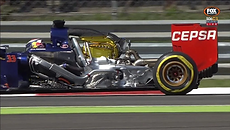

I think that’s quite an interesting idea. Constraints force creativity, but at the same time, having complete freedom can also lead to something unique. In F1, you’re always working within strict rules, yet the best designers still find ways to stand out. It’s less about breaking rules and more about interpreting them differently. That’s where design becomes more than just problem-solving, it becomes strategic.
A lot of the design in F1 also goes completely unnoticed. Most people see the car as a whole, but not the internal layout, the materials, or the small aerodynamic details that actually make the difference. That applies to products as well. The things that define performance are usually the things users never see. Newey’s work is rarely appreciated visually, but the results speak for themselves.
I do think sometimes design is judged too heavily on aesthetics. What something looks like becomes the main focus, when in reality, performance and function can be far more important. The best design isn’t always the most obvious, it’s the one that works the best. And in Newey’s case, that’s exactly what you see. It’s not about creating something that looks impressive, it’s about creating something that performs at the highest level.
So going back to the original question, can one designer dominate a sport? I think the answer is yes. Looking at Newey’s career, across different teams, different eras, and different regulations, he’s consistently produced cars that win. That doesn’t take away from other engineers or designers in F1, because there have been plenty of incredible cars over the years, but no one has really matched that level of consistency.
F1 might look like a sport, but it’s also a design competition under extreme conditions. Everything you see on track is the result of thousands of design decisions. And because of that, a lot of the time, even before the race begins, you can already roughly predict what’s going to happen. Not perfectly, but enough to see that performance has already been shaped long before the lights go out.