
Between Art and Vandalism
The language of graffiti
Graffiti has always stood out to me whenever I’m in a different city. Growing up in Hong Kong, it wasn’t something I would say the city is known for, but it was still everywhere if you looked closely. At the time, I never really questioned it. It was just there. As a kid, I saw it as random scribbles or messy colour on walls. Something unplanned and a bit chaotic. But as I’ve grown up and started to pay more attention to design, that perception has shifted. It feels more intentional now. Almost like every piece has a reason for existing, even if that reason isn’t immediately obvious.
What I find interesting is that graffiti sits in this uncomfortable space. It is often unwanted and technically illegal, but at the same time, it can be visually powerful and clearly skilled. Not everyone can create it well. There is a level of control and understanding of form that you only really notice once you start looking at it differently. I am not trying to defend graffiti here, but I do think it exists as a kind of design that sits outside normal rules. And that makes it harder to define in simple terms.

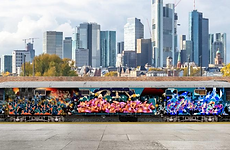


The more I’ve looked at graffiti, the more I’ve started to see it as something that reflects the city itself. Almost like a social mirror. It feels like it responds directly to its environment. You tend to notice it more in certain areas. Sometimes, there is tension, neglect, or just a stronger youth presence. Other times, it feels more playful, like people just doing it for expression or enjoyment. But in many cases, it feels like a reaction to something rather than just decoration.
That is what makes it interesting from a design point of view. Unlike signage, advertising, or architecture, graffiti is not approved or controlled. It is not part of an official system. It is unfiltered, which makes it feel more direct and more honest in a way. It captures something about a place in real time. Not how a city wants to be seen, but how it actually feels on the ground. That is quite different from most designed environments, which are usually carefully managed and polished.
What I’ve started to realise is that graffiti is not just random marks. It has its own design language. A lot of graffiti is built around typography, even if it is distorted or hard to read. Letters are stretched, overlapped, and exaggerated. Sometimes they become almost unreadable, but that feels intentional. It shifts the focus away from clarity and more towards identity and style. Each artist develops a consistent way of working. A tag becomes more than a name. It becomes a visual signature. Almost like a branding system, but one that exists outside commercial design. That repetition builds recognition over time.
There is also a lot of control in how it is constructed. Colour choices, layering, contrast, and even 3D effects are all used to make work stand out in very chaotic environments. It is designed to be noticed, but also designed to survive visually in busy spaces. The more you look at it, the more you realise there is real skill involved. Spray paint is not easy to control, especially quickly and often in difficult environments. That adds another layer to it. It is not just a visual expression, it is also a technical ability.


One thing I first learned about graffiti quite early on was that it is not just individual work. There is a whole hidden community behind it. I remember hearing about it from a teacher when I was younger, and it stuck with me. There is this idea that people within graffiti culture recognise each other’s work, styles, and tags, even if no one outside that world really understands it.
That is what makes it feel quite exclusive in a way. You can look at it from the outside and think it just looks cool or random, but a lot of the meaning sits within the culture itself. It is something you have to be part of to fully read. Reputation is not built through formal systems or platforms. It is built visually, through repetition and location. Certain artists become known within that network without ever being publicly known.
There is also a risk element to it. The illegal nature of graffiti adds urgency and adrenaline, which also affects how and where it is made. When you see something in a hard-to-reach or unusual place, it carries more weight because you understand the effort behind it. In a way, it operates like a design network, but without institutions, clients, or approval.
This is where graffiti becomes more than just a visual expression. It becomes part of a wider counterculture. Counterculture, to me, is anything that exists against the dominant system. It rejects control, commercialisation, and traditional ideas of what design should look like. When you compare graffiti to other movements like punk design or skate culture, you start to see similarities. Punk is rough, direct, and often deliberately anti-polished. Skate culture uses stickers, graphics, and public space in a way that feels similar in spirit. Even zines operate in the same way, where the focus is on expression over perfection.
Graffiti sits within that same mindset. It is independent, rebellious, and often temporary. But what makes it different is that it applies that thinking directly to the city itself. Most design is made for someone. Graffiti feels like it is made despite someone.


There is always a conflict with graffiti. Whether it is art or vandalism. On one hand, it is easy to understand why people see it as vandalism. It is often done without permission, it can damage private property, and it can contribute to spaces feeling less maintained or less safe. Not all graffiti is visually strong, either. Some of it is just tagging with no clear intention beyond marking a surface.
At the same time, some pieces clearly go beyond that. They add identity to a place. They break up the monotony of modern urban environments, which can often feel very controlled and repetitive. In those cases, graffiti almost gives a space a sense of personality.
My own opinion on it changes depending on what I am looking at. Some graffiti does feel like damage. Other pieces feel like they belong there more than anything else around them. That tension is what makes it interesting. It forces you to question what we actually consider good or bad design in public space.
At the core of it, graffiti sits in this strange space between design and non-design, control and expression, official and unofficial systems. It challenges the idea that good design has to be controlled, approved, or even wanted. Instead, it exists as something more immediate and reactive.
It is not always something that makes a city look better in a traditional sense. But it does make it feel more alive. More real. And maybe that is what makes it interesting from a design perspective. Not whether it fits within the rules, but whether it reflects something about the world that the rules miss.